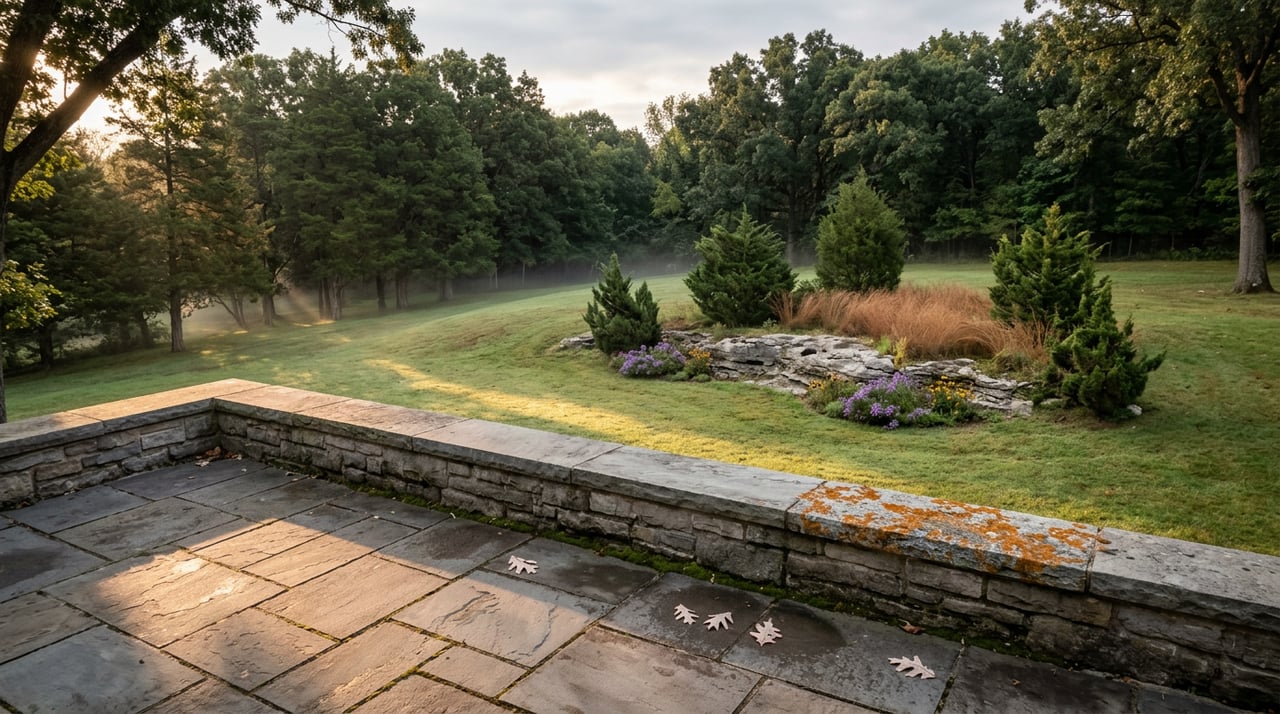
Cedars of Lebanon's Disc Course Has Been Played Since 1977, and Fall Is When Wilson County Actually Uses the Park
September 17, 2026
September 17, 2026
Drive south on Route 231 toward the park entrance and you will pass a hand painted sign pointing toward "frisbee golf parking," past the splash pad turnoff, toward a gravel lot most people never stop at. It has been pointing the same direction for nearly fifty years. The 18 hole course tucked into the cedar woods at Cedars of Lebanon State Park was laid out in 1977 with help from Ed Headrick, the man credited with inventing modern disc golf. One longtime player reviewing the course on Disc Golf Course Review guesses it ranks around third oldest still in operation in the state, a claim nobody has formally ranked but one that lines up with how the course plays: short, tight, and clearly designed before the sport had settled on modern conventions.
Most people who live near the park know it for one of two things: the campground or the splash pad. Both are real draws, and both close for the season around Labor Day. What closes down is the crowd. What does not close down is the part of the park that was actually built to be used the other nine months of the year, and fall is when the gap between the two becomes obvious to anyone paying attention.
The disc course plays as a technical, tight par 54 across 4,300 feet, with fifteen holes under 300 feet and three stretching past that. It runs entirely through cedar and hardwood, with no open air shots and no shared use with picnic traffic. That is by design. The park set the whole course aside as its own dedicated corridor, which is part of why it still draws steady play after nearly fifty years. On UDisc, the course carries a 3.9 star average across more than 1,000 community ratings, a strong number for a layout that has not been substantially redesigned since the Carter administration.
Players who spend time on the Tennessee circuit will tell you Cedars of Lebanon plays differently than newer courses like Valhalla in Watertown or The Shire near downtown Lebanon, both a short drive away. Those courses were built with modern spacing in mind. Cedars was built when the whole idea was new, and it shows in the tight lines and short, technical holes that reward accuracy over distance. That is not a knock. It is the reason regulars keep coming back to a course that, by disc golf standards, is genuinely historic.
Here is the part that surprises most residents. Cedars of Lebanon is not a fixed footprint that got carved out once in the 1930s and left alone. It is still being added to, acre by acre, through land conservation deals that rarely make it past a single news cycle.
In 2023, TennGreen Land Conservancy partnered with the Tennessee Department of Environment and Conservation to add 15 acres to the park boundary, following an earlier 5 acre addition in 2021. The reasoning was not about campsites or trail mileage. It was about the cedar glades themselves, the rare limestone barrens that ring the park and support plants that grow almost nowhere else on earth. The acquisition was aimed specifically at protecting habitat for the Tennessee coneflower, Nashville breadroot, limestone fameflower, and the endangered leafy prairie clover, species that depend on the thin, rocky soil found in this particular pocket of the Central Basin.
TennGreen's executive director Alice Hudson Pell framed the acquisition as exactly the kind of parcel a conservancy has to move on quickly, since undeveloped land bordering an existing park is often the first to attract a builder's attention. That framing matters for anyone who lives nearby. The park boundary you see on a map today is not the boundary it will have in five years. It is expanding in small, deliberate bites specifically because the glades around it are rare enough that losing even a few acres to a subdivision would matter ecologically in a way most land in Middle Tennessee simply does not.
Park manager Jeff Buchanan has said as much directly. Most visitors show up during camping season, get their first taste of the park from a campsite, and only later branch out into the trails. That pattern makes sense given the calendar. The splash pad runs Memorial Day to Labor Day. Camping peaks with it. Once both wind down, so does the traffic, even though the trails themselves get better, not worse.
The park maintains about eight miles of hiking across five named routes, none of them strenuous:
None of that changes in October. What changes is the humidity, which drops enough that a five mile loop stops feeling like a chore, and the crowd, which thins enough that you are not sharing the Cedar Glades Trail with a dozen other families. The disc course gets the same benefit. Regulars who play it in July know the tree cover cuts the sun but not the heat. In fall it just gets pleasant.
The park's nature center, run out of the historic building named for local newspaperman Dixon Merritt, keeps its own rhythm going regardless of season. Interpretive ranger Shauna Bridgers works with rehabilitated animals there, including a non venomous corn snake named Maisey who lost part of her tail before coming to the park. Bridgers uses her, and the rest of the ambassador animals, to walk visitors through the difference between the snakes worth worrying about and the ones quietly doing pest control in the glades. It is a small program, but it runs on a schedule that does not care whether the splash pad is open.
The Cedar Forest Lodge, built between 1935 and 1937 by Civilian Conservation Corps crews as part of the same New Deal era effort that reclaimed the land for the park, still gets steady use today. Buchanan has described weekends where the lodge hosts two or three weddings back to back. That is a lot of local families walking through a 90 year old building without necessarily registering that it was built by the same federal program that put roads and shelters in state parks across the country. It is one more example of the park doing more than its reputation suggests, quietly, in a building most people assume is decorative.
If you want a concrete reason to actually make the drive before the season turns, the park is hosting a National Public Lands Day and TNServes volunteer event on September 26, alongside a separate volunteer day at the historic Sadie Ford Heritage Farm on the same grounds. Both are hands on opportunities to work inside a park that, as this piece has laid out, is still actively growing and still actively protecting rare habitat most visitors never think about. It is a low key way to see the parts of Cedars of Lebanon that do not show up on a splash pad brochure.
None of this requires planning a trip. For most Wilson County residents, the park is a fifteen or twenty minute drive at most. The version of it worth seeing this month is not the one lined up for summer. It is the quieter one: a disc course with real history behind every tee pad, a boundary that keeps expanding for reasons rooted in genuinely rare botany, and trails that are finally comfortable to walk the full length of.
If you are weighing what life actually looks like day to day in Wilson County, this is the kind of detail that tells you more than a listing ever will. For questions about the neighborhoods around it, Just Call Kari.
Stay up to date on the latest real estate trends.


Get assistance in determining current property value, crafting a competitive offer, writing and negotiating a contract, and much more. Contact me today.